
Berlin, October 31, AZERTAC
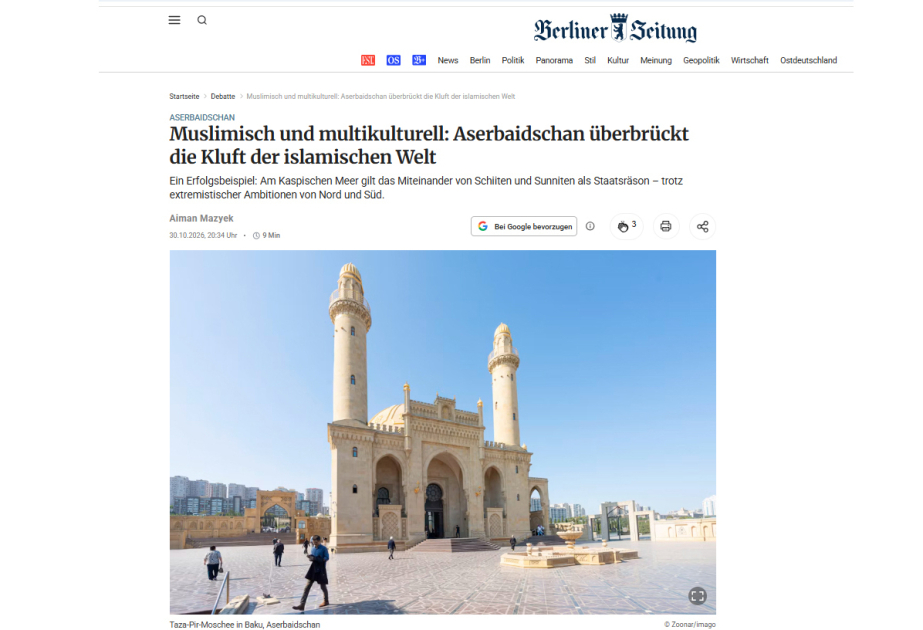
Germany’s Berliner Zeitung has published an article highlighting Azerbaijan’s multicultural environment and its distinctive model of relations between religion and the state.
The article was written by Aiman Mazyek, former chairman of the Central Council of Muslims in Germany, who examines Azerbaijan’s experience of religious coexistence and multiculturalism.
The author contrasts Azerbaijan’s approach with tensions between Sunni and Shia Muslims in parts of the Middle East and Gulf region, where historical divisions are sometimes exploited for political purposes. He describes Azerbaijan as an example of peaceful coexistence, noting that Sunni and Shia Muslims in Baku pray side by side in the same mosques.
Although Shia Muslims account for approximately 70 percent of Azerbaijan’s population, the Caucasus Muslims Board (CMB), headed by Sheikhulislam Allahshukur Pashazade, represents the country’s Muslim community as a whole. The appointment of Sunni mufti Salman Musayev as the CMB chairman’s deputy, the article says, reflects the institutional nature of Sunni-Shia unity.
Drawing on his visits to Azerbaijan, Mazyek also highlights the peaceful coexistence of Muslim, Jewish, Catholic, Protestant and Russian Orthodox communities. He cites Ashura blood-donation campaigns involving leaders of different religious communities as an example of solidarity that transcends religious affiliations.
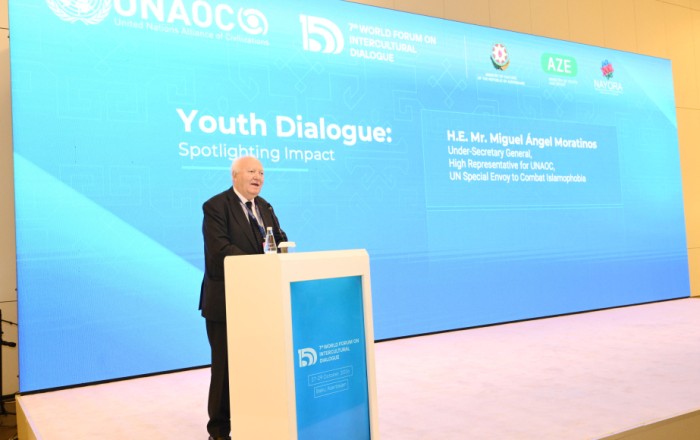
The article notes that Azerbaijan’s multiculturalism policy receives support at the state level. It highlights the Baku Process, launched in 2008 on the initiative of President Ilham Aliyev, and the World Forum for Intercultural Dialogue, held since 2011. Organized in cooperation with UNESCO, the UN Alliance of Civilizations and ICESCO, these initiatives demonstrate Azerbaijan’s contribution to international dialogue, the author says.
However, Mazyek argues that the country’s most important achievement lies not only in international forums but also in the everyday relationships among people in families, neighbourhoods and places of worship.
The article also points to challenges posed by religious extremism, ideological pressure and disinformation campaigns. Citing research, the author argues that preventing radicalization requires more than administrative measures: ensuring that no religious community feels excluded and that all are treated equally is essential to preserving social cohesion.
According to Mazyek, Azerbaijan’s approach to religious coexistence, together with its independent and peace-oriented policies, helps prevent regional conflicts and external pressures from spilling over into religious and sectarian divisions.
He concludes that Azerbaijan’s experience offers hope for the wider Islamic world, demonstrating that peaceful coexistence among different Muslim denominations is both possible and essential to fostering peace and dialogue.
Source: azertag.az






 scorpion.az
